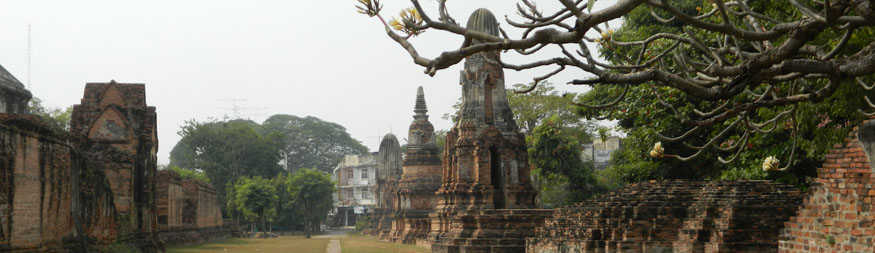
Wat Nakhon Kosa……..(right). Wat Nakhon Kosa is a temple which Had undergone 3 periods of construction, beginning with construction of the large pagoda in Dvaravati period, followed by the Prang (Khmer style structure) of Lopburi style and the latest period was the restoration of the site as a temple in the Ayutthaya period. It is hypothesized that Chao Phraya Kosathibodi (Lek), a high ranked official in the reign of King Narai the Great was the person who had carried out the restoration. The temple was consequently known as ‘Wat Nakhon Kosa’.
Prang Khaek Sanctuary……..(far left). Prang Khaek is a Hindu sanctuary with Lopburi artitecture. The sanctuary dates from around the 10th century and comprises 3 prangs (Khmer style structure with high spire) standing in a row, facing east. In the Ayutthaya period, King Narai the Great had kindly constructed the Vihara (chapel) , Brahmin Hall and water reservoir.
San Phra Kan (Phra Kan Shrine)……..(near left). San Phra Kan is a Hindu sanctuary build of laterite with a high indented cornered base and stairs on 4 sides but th consists of a large prang 30.7 he body of the chamber has collapsed. Several ancient objects have been discovered on the grounds of the shrine including a 19th century inscription now exhibited at the National Museum, Bangkok, a Vishnu statue, reclining Vishnu lintel now exhibited at Somdet Phra Narai National Museum and Avalokitesvara Bodhisttva now enshrined at the new San Phra Kan shrine.
Phra Prang Sam Yot……..(right). Phra Prang Sam Yot is a monument built of laterite, consisting of 3 prangs standing in a row connected by corridors. The main prang is is 21.5 metres in height. The monument is of Lopburi style dated early 13th century. Originally inside the prang was enshrined a Buddha in Nak Prok (Buddha seated under a Naga shelter) posture now exhibited at the Somdet Phra Narai National Museum.
Wat Phra Si Rattana Mahathat……..(left). Wat Phra Si Rattana Mahathat or Wat Phra That is a religious site which comprises a large prang, 30.7 metres high at the centre of the temple grounds flanked by smaller prangs to the north and south with only the bases remaining today. From the architecture of the decorative stuccos around the remaining structures, it is believed that the monument was built in the early 14th century. During his reign, King Narai the Great ordered the reconstruction of the temple and added pagodas, galleries and a vihara.
Phra Narai Ratchaniwet……..King Narai the Great (1656-1688) build a palace in the town of Lopburi in 1666 as a royal residence. The palace was built by the French and Italians. It was in use annually over a long period and the King died there. After that no other monarchs resided at the palace until the reign of King Rama IV who restored and reconstructed the palace, as well as adding new buildings in the palace grounds. At present the palace houses the Somdet Phra Narai National Museum.
Phra Narai Ratchaniwet is divided into 3 areas:
(1) Outer Palace Precinct (right): containing important structures such as Teuk Phra Chao Hao building, Sip Song Thong Phra Klong (the 12 Treasures), Tuek Liang Khaek Muang (State Visitors Reception Hall, Water Reservoir and Royal Elephant Stable.
(2) Middle Royal Precinct: containing 2 pavilions built in reign of King Narai the Great, Phra Thinang Chantharaphison and Phra Thinang Dusitsawan Thanyamahaprasat. In the Rattnakiosin period, King Rama IV constructed Phra Thinang Phimanmongkut complex and Thim Dap (Swordsman house).
(3) Inner Royal Precinct: consisting of Phra Thinang Sutthasawan, which was the private residence of King Narai the Great and Phra Prathiap, a group of eight buildings built in the reign of King Rama IV.
Ban Luang Rap Ratchathut (Ban Wichayan)……..(far left). Ban Wichayan was built by King Narai the Great as residences for foreign envoys and priests in Lopburi. Later, when a Greek named Constantine Falcon came to work in the court and was promoted by the King as ‘Chao Phraya Wichayen’, he was granted a residence to the west of Ban Luang Rap Ratchathut. Most buildings are of Western classic architecture of Baroque style mixed with the Thai style of King Narai the Great’s reign.
Ban Peun……..(near left). Wat Peun is located in the northwestern area of the ancient town of Lopburi. A map of 1687 confirms that the area is a temple. The structure at Wat Peun consists of a square-based stupa and a rectangular vihara (chapel or preaching hall) which was influenced by western-style architecture with small niches in the inner wall. The temple was first built in the 15th century and remained in use until the 17th century. After several attempts at repair it finally collapsed and was abandoned.