Sisowath Quay aka Riverside…….. This an attractive boulevard running along the banks of the Mekong and Tonle Sap. It's fronted by a large, long open space with manicured lawns, palm trees and open pathways, all recently re-done as part of a Japanese funded project to upgrade the flood infrastructure along the river. The built-up side of the street is home to cafés and shops and the better class of bar, and is popular with tourists and expat Westerners.
Wednesday 20th February
Toul Sleng Genocide Museum........Toul Sleng Genocide Museum is situated in the suburbs south of Phnom Penh It is the former security office 21 in ‘Democratic Kampuchea’ created by order of Pol Pot (Sa lut Sor) on April 17, 1975. Immediately after liberation on 7th January 1979 the appointed government began to collect evidence from S-21 including photographs, films, prisoner confessions, torture tools and shackles and fourteen corpses in the compound all left behind when the Khmer Rouge fled. Today the graves of the fourteen bodies including that of a woman can be seen in the courtyard while much of the evidence presented to the Kampuchea People’s Tribunal is on display in the four building blocks A-D which surround the courtyard. Building block A was used for detainees accused of leading the uprising against the revolution. Buildings B-D had a different function. The former classrooms on the ground floor were divided into small cells with brick walls while the upper floors had large cells where prisoners were crowded together. Outside in the yard is a wooden poll which was turned into an interrogation and torture machine. It is estimated that 20,000 people may have been processed through S-21 between 1975 and 1978. Finally, the torture methods portrayed in the photographs and sketches are as gruesome as ever can be designed in the minds of humanity. They are simply horrific. Entry $2.
The Choeung Ek Genocide Centre....... Choeung Ek is the site of a former orchard and Chinese graveyard about 17 km south of Phnom Penh, Cambodia, is the best-known of the sites known as The Killing Fields, where the Khmer Rouge regime executed over one million people between 1975 and 1979. Mass graves containing 8,895 bodies were discovered at Choeung Ek after the fall of the Khmer Rouge regime. Many of the dead were former political prisoners who were kept by the Khmer Rouge in their Tuol Sleng detention center.
Today, Choeung Ek is a memorial, marked by a Buddhist stupa. The stupa has acrylic glass sides and is filled with more than 5,000 human skulls. Some of the lower levels are opened during the day so that the skulls can be seen directly. Many have been shattered or smashed in.
Tourists are encouraged by the Cambodian government to visit Choeung Ek. Apart from the stupa, there are pits from which the bodies were exhumed. Human bones still litter the site.
On May 3, 2005, the Municipality of Phnom Penh announced that they had entered into a 30-year agreement with JC Royal Co. to develop the memorial at Choeung Ek. As part of the agreement, they are not to disturb the remains still present in the field.
The film The Killing Fields is a dramatized portrayal of events like those that took place at Choeung Ek. Entry $5.
Thursday 21st February
The Royal Palace........The Royal Palace is a complex of buildings which serves as the royal residence of the king of Cambodia. Its full name in the Khmer language is Preah Barum Reachea Veang Chaktomuk Serei Mongkol. The Kings of Cambodia have occupied it since it was built in 1860's, with a period of absence when the country came into turmoil during and after the reign of the Khmer Rouge. The palace was constructed after King Norodom relocated the royal capital from Oudong to Phnom Penh in the mid-19th century. It was gradually built atop an old citadel called Banteay Kev. It faces towards the East and is situated at the Western bank of the cross division of the Tonle Sap River and the Mekong River called Chaktomuk . In the week ended 7 February, 2013 the royal funeral of Cambodia’s late King Norodom Sihanouk took place when his remains were taken from the cremation site to keep in the royal palace in a procession.
The National Museum of Cambodia........The National Museum of Cambodia, situated near the Royal Palace on the bank the Tonle Sap River houses one of the world's largest collections of Khmer art, including sculptural, ceramics, bronzes, and ethnographic objects. The Museum’s collection includes over 14,000 items, from prehistoric times to periods before, during, and after the Khmer Empire, which at its height stretched from Thailand, across present-day Cambodia, to southern Vietnam. The Museum buildings, inspired by Khmer temple architecture, were constructed between 1917 and 1924. The museum was officially inaugurated in 1920, and renovated in 1968.
King Sihanouk memorial........The King Sihanouk memorial stands alongside the Royal Palace. It was build to honor the passing of King Norodom Sihanouk whose state funeral was held at the beginning of February 2013.
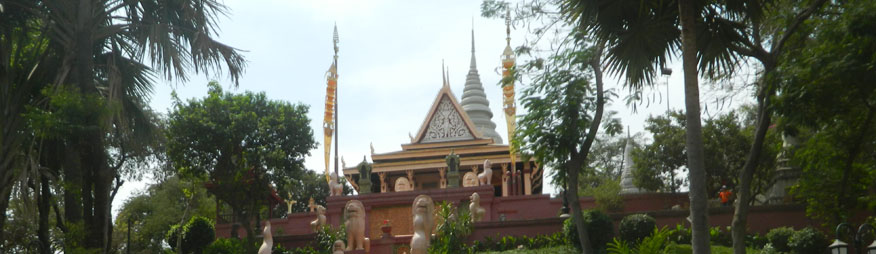
Wat Phnom........ Wat Phnom is a Buddhist temple (wat) in Phnom Penh. It was built in 1373, and stands 27 metres (88.5 ft) above the ground. It is the tallest religious structure in the city. The pagoda was given the name of Wat Preah Chedey Borapaut. Legend relates that Daun Penh, a wealthy widow, found a large koki tree in the river. Inside the tree she found four bronze statues of the Buddha. Lady Penh constructed a small shrine on an artificial hill made by the people living in the village to protect the sacred statues. Eventually this became a sacred site and sanctuary where people would make blessings and pray. The sanctuary itself was rebuilt several times in the 19th century and again in 1926 but during the Khmer Rouge regime the temple was badly damaged and reconstructed as was much of the city of Phnom Penh.
Phnom Penh Railway Station........At this time Phnom Penh Railway Station is closed, locked shut, with little evidence of activity. However in a statement by CEO of Toll Royal Railway, Davis Kerr on 7 January 2013, a limited freight service commenced on 28 December between Phnom Penh and Sihanoukville. Operating 3 return container services per week the plan is to gradually increase the load up to around 3,0 00 tons. He also confirmed that presently reconstruction work is progressing on sections of line that will complete the link as far as the Thai border. These are principally the section between Phnom Penh and the railway junction at Bat Doeng and a section between Sisophon and Poi Pet. The planned opening of this line is September 2013. In the meantime the company has commissioned locomotives and rolling stock and is constructing a repair shop near Phnom Penh.
SIEM REAP and ANGKOR WAT HISTORICAL PARK - Tourist Sites in Detail
Saturday 23rd February
Pub Street........After the sun goes down, the focus falls to “Pub Street’” and Pub Street alleys named for the numerous pubs that line Street 8. It all began in 1998 when Angkor What? Bar opened its doors – the lone pub on an otherwise quiet street. These days Pub Street is packed end to end with a varied collection of restaurants, pubs, boutiques and shops, making the area the tourist centre of town.
Night Market........The Night Market lies across the Siem Reap River opposite the Old Market area. It offers a wide range of handicrafts, souvenirs, clothing etc. After dark it complements the night-life atmosphere with brightly lit shops approached by equally attractive brightly lit foot bridges.
Sunday 24th February
Angkor Thom........Constructed: Late 12th – Early 13th century C.E. Religion: Buddhism. King/Patron: Jayavarman VII. Style: Bayon.
Angkor Thom (Big Angkor) is a 3km walled and moated royal city and was the last capital of the Angkorian empire. After Jayavarman VII recaptured the Angkorian capital from the Cham invaders in 1181, he began a massive building campaign across the empire, constructing Angkor Thom as his new capital city. He began with existing structures such as Baphuon and Phimeanakas and built a grand enclosed city around them, adding the outer wall/moat and some of Angkor’s greatest temples including his state-temple, Bayon set at the centre of the city. There are five entrances (gates) to the city, one for each cardinal point, and the victory gate leading to the royal palace area. Each gate is crowned with 4 giant faces. The South Gate is usually the first stop on a tour.
Bayon (Angkor Thom)........Constructed: Late 12th century C.E. Religion: Buddhism. King/Patron: Jayavarman VII. Style: Bayon.
Next to Angkor Wat, Bayon is the most significant structure in the Park. The giant stone faces of Bayon have become one of the most recognizable images connected to classic Khmer art and architecture. There are 37 standing towers, most but not all sporting four carved faces oriented towards the cardinal points. Who the faces represent is a matter of debate but could be a combination of Buddha and Jayavarman VII himself. The state-temple in many ways represents the pinnacle of the latter’s massive building campaign. The temple’s general appearance is somewhat of a muddle in part because it was constructed in piecemeal fashion for over a century. Apart from the carved faces, a most interesting aspect of Bayon’s architecture is the wealth of bas reliefs starting at lower levels and rising onto the towers themselves. Depicted are battle scenes probably from encounters with the Cham but elsewhere scenes from everyday life exist on outer structures. Interestingly there are carvings from a latter period found on inside walls. These are of Hindu origin relating to the reign of Jayavarman VIII.
Baphuon (Angkor Thom)........Constructed: Mid 11th century C.E. Religion: Hindu. King/Patron: Udayadityavarman II. Style: Baphuon.
Baphuon is an earlier temple-mountain later enclosed within the new city of Angkor Thom. It was in poor condition, the main structure collapsed and in ruin. However restoration work in the main temple area has allowed some access for visitors who enter the site via an exterior gate and elevated causeway. Of most interest are the unique animal carvings at the walkway entrance and a large reclining Buddha on the west side which was added later.
Phimeanakas (Angkor Thom)........Constructed: Early 11th century C.E. Religion: Hindu. King/Patron: Jayavarman V. Style: Kleang.
Phimeanakas is a pyramid constructed from laterite and sandstone. Today it is uninspiring bereft of it original sandstone carvings. Located inside the Angkor Thom Royal Palace compound it is a former king’s palace from an earlier period. The legend associated with this structure is interesting. It is said to have had a golden tower inhabited by a serpent which could change into a woman. In order to protect the kingdom the kings of Angkor were required to make love with the serpent everynight.
The Terrace of the Elephants (Angkor Thom)........ Constructed: Late 12th century C.E. Religion: Buddhism. King/Patron: Jayavarman VII. Style: Bayon.
Terrace of the Elephants is an impressive, two and a half metre tall, 300 metre long terrace wall adorned with carved elephants and garudas that spans the heart of Anchor Thom in front of Baphuon, Phimeanakas and the Royal Palace area. The northern section of the wall displays some fine sculptures including the five-headed horse and scenes of warriors and dancers. At the north end of the terrace is the Terrace of the Leper King.
Terrace of the Leper King (Angkor Thom)........ Constructed: Late 12th century C.E. Religion: Buddhism. King/Patron: Jayavarman VII. Style: Bayon.
The Terrace of the Leper King is situated at the north end of the Terrace of the Elephants and consists of a double terrace with carved nagas, demons and other mythological beings. The inner wall was only excavated in the 1990’s having been covered over when the outer wall was built. On top of the terrace sits a Buddha image which is a replica of the original one that now resides in the National Museum in Phnom Penh. The origin of the name of the terrace is unclear but it is thought to relate to the condition in which the image was found. As with the large heads at Bayon, it is thought that the image of the Buddha is in Jayavarman VII’s own style.
Tep Pranam (Angkor Thom)........ Constructed: 9th century C.E. Religion: Buddhist. King/Patron: Yasovarmin I. Style: Mixed.
Tep Pranam consists of a long walkway with a Buddha figure at the far end. It was originally a Buddhist shrine built under Yasovarmin I who moved the capital to Angkor. It was expanded over the years with 12th century balustrades, 13th century lions and significant post-Angkorian additions. The Buddha image situated at the far end is made of recycled material but it's age is unclear. As with much of this area detail of the post Angkorian period is missing as the area came under Siamese control in the 15th century.
Ta Keo........ Constructed: Late 10th - Early 11th century C.E. Religion: Hindu (Shiva). King/Patron: Jayavarman V. Style: Khleang.
Ta Phrom is a towering but plainly decorated temple-mountain dedicated to Shiva. It was known as the ‘mountain with golden peaks’. I was the first temple constructed wholly of sandstone blocks. Construction started under King Jayavarman V who broke with tradition by building his state-temple outside the main capital area. Building continued during the reigns of Jayaviravarman and Suryavarmin but the lack of carvings suggests the decorating phase discontinued at an early stage.
Ta Phrom........ Constructed: Mid 12th - Early 13th century C.E. Religion: Buddhism. King/Patron: Jayavarman VII. Style: Bayon.
Ta Phrom is yet another temple complex constructed by the prolific builder Jayavarman VII. This sprawling walled complex lies outside the main city and is notable as an example to all of the effects of jungle overgrowth which threatens to engulf these precious structures. So far there has been resistance to the clearing of massive fig and silk-cotton trees that grow from towers and corridors creating a jungle atmosphere which adds mystique to this site and fascination for tourists. Some of the site’s monastic structures are gradually being restored while others are left alone to natural forces. The complex itself is Jayavarman VII’s first major temple project and dedicated to his mother. Ta Phrom was originally constructed as a Buddhist monastery and was extremely wealthy boasting control over 3,000 villages, thousands of support staff and vast stores of jewels and gold.
Prasart Kravan........ Constructed: Early 10th century C.E. Religion: Hindu (Vishnu). King/Patron: Harshavarman I. Style: Bakheng.
Prasat Kravan is a small temple to the east of the main city. Its east-facing brick towers contain unique bas-reliefs of Vishnu and Lakshmi rendered in brick – the only example of brick bas-reliefs in the Angkor area. It was build my noblemen rather than a king. It is twinned with another temple in Takeo Province, south of Phnom Penh. Prasat Kravan was reconstructed in the early 20th century using replacement bricks where necessary.
Prasart Angkor Wat........ Constructed: Early – Mid 12th century C.E. Religion: Hinduism (Vishnu). King/Patron: Suryavarman II. Style: Angkor Wat..
Angkor Wat is visually, architecturally and artistically breathtaking. It is a massive three-tiered pyramid crowned by five lotus-like towers rising 65 metres from ground level. Angkor Wat is the centerpiece of any visit to the temples of Angkor.
At the apex of Khmer political and military dominance in the region, Suryavarman II constructed Angkor Wat in the form of a massive ‘temple-mountain’ dedicated to the Hindu god, Vishnu. It served as his state temple, though the temple’s uncommon westward orientation has led some to suggest that it was constructed as Suryavarman II’s funerary temple. There are other temples of the same style and period which may have served as prototypes to Angkor Wat.
Angkor Wat is surrounded by a moat and an exterior wall measuring 1,300 metres x 1,500 metres. The temple itself is 1 km square and consists of three levels surmounted by a central tower. The walls of the temple are covered inside and out with bas-reliefs and carvings. Nearly 2.000 distinctively rendered apsara carvings adorn the walls throughout the temple and represent some of the finest examples of apsara carvings in Angkorian era art. But it is the exterior walls of the lower level that display the most extraordinary bas-reliefs, depicting stories and characters from Hindu mythology and the historic wars of Suryavarman II which are worth much more than just passing interest.
The representations on the exterior walls include: the mythological Battle of Kuru, the historical march of the army of Suryavarman II against the Cham, scenes from Heaven and Hell and the classic ‘Churning of the Ocean of Milk’.
Although Angkhor Wat was constructed as a Hindu temple it served as a Buddhist temple when Buddhism became the prominent religion in the 14th century.
Monday 25th February
Siem Reap Old Market........The Old Market alongside the Siem Reap River offers the widest selection of souvenirs and curious on all sides of the market but particularly on the riverside. It is central to the Night Market on the other side of the river and to the up-market restaurants in Pub Street. However, a wide selection of fare is available including Western, Indian, Chinese and of course traditional Khmer all at reasonable prices. The whole area of downtown Siem Reap comes to life after dark.